It learns. It deepens.
Your root system gets smarter every time you use it. Structured memory, compound learning, a system that remembers what matters. This is how it deepens.
This module's pack
Module 2 pack: memory and your network
Drop this module's skills and guides into your system and keep building on your foundation.
See what's inside (12 files)
Skills (8)
/context-status · /crm · /crm-log · /import-linkedin · /lead-enrichment · /network-analysis · /save-session · /scratchpad
Build guides (3)
Step-by-step, one per piece: Memory system · Organizing your knowledge · What Claude can reach (security rules update). Plus the pack README that installs it all.
Unzipped it and something looks missing?
Your skills install into a folder named .claude. It starts with a dot, so your Mac or PC hides it by default. Nothing is missing. To show hidden files on Mac, press Command + Shift + . (period) in Finder. On Windows, open View → Show → Hidden items in File Explorer.
👇 After this module
You understand what gets saved and where, what Claude can reach, how memory tiers work, how to teach your system every day, and how it holds your people: a CRM in your own files, fed with your real network.
What you'll do in this module
- What actually gets saved, see how Claude turns your conversations into memory you can trust
- What Claude can reach, set the folder boundary and audit the permissions that outlive your sessions
- Your memory system, understand the working layers and where each piece of knowledge lives
- Teaching it more every day, learn the small habits that compound into a system that knows you
- Your fact files, fill in identity, business, preferences, and decisions in plain language
- The map and the terrain, organise your knowledge so Claude knows what to load and when
- Your CRM, meet the contact system that lives in your own files and log your first real person
- Teaching it your network, import your LinkedIn connections and let Claude classify them by ICP fit
What you'll leave with
- A memory system that knows what to keep and what to let go
- Your fact files filled in across all four languages
- Your LinkedIn network imported and classified by fit
- A CRM in your own files: contacts, promises, and next steps Claude keeps for you
- Confidence that your system remembers across sessions, not just within them
- A permission list you have read and chosen on purpose
Why this matters
Memory is what turns Claude from a helpful tool into a system that knows you. Without it, every conversation starts from zero.
You do not build a complete memory system in one sitting. You start with a few facts, a few preferences, and it grows from use. Every conversation adds something. Every save makes it smarter. The system deepens because you use it, not because you filled in every field on day one.
Start here
Lesson 1: What actually gets saved →
What actually gets saved 💾
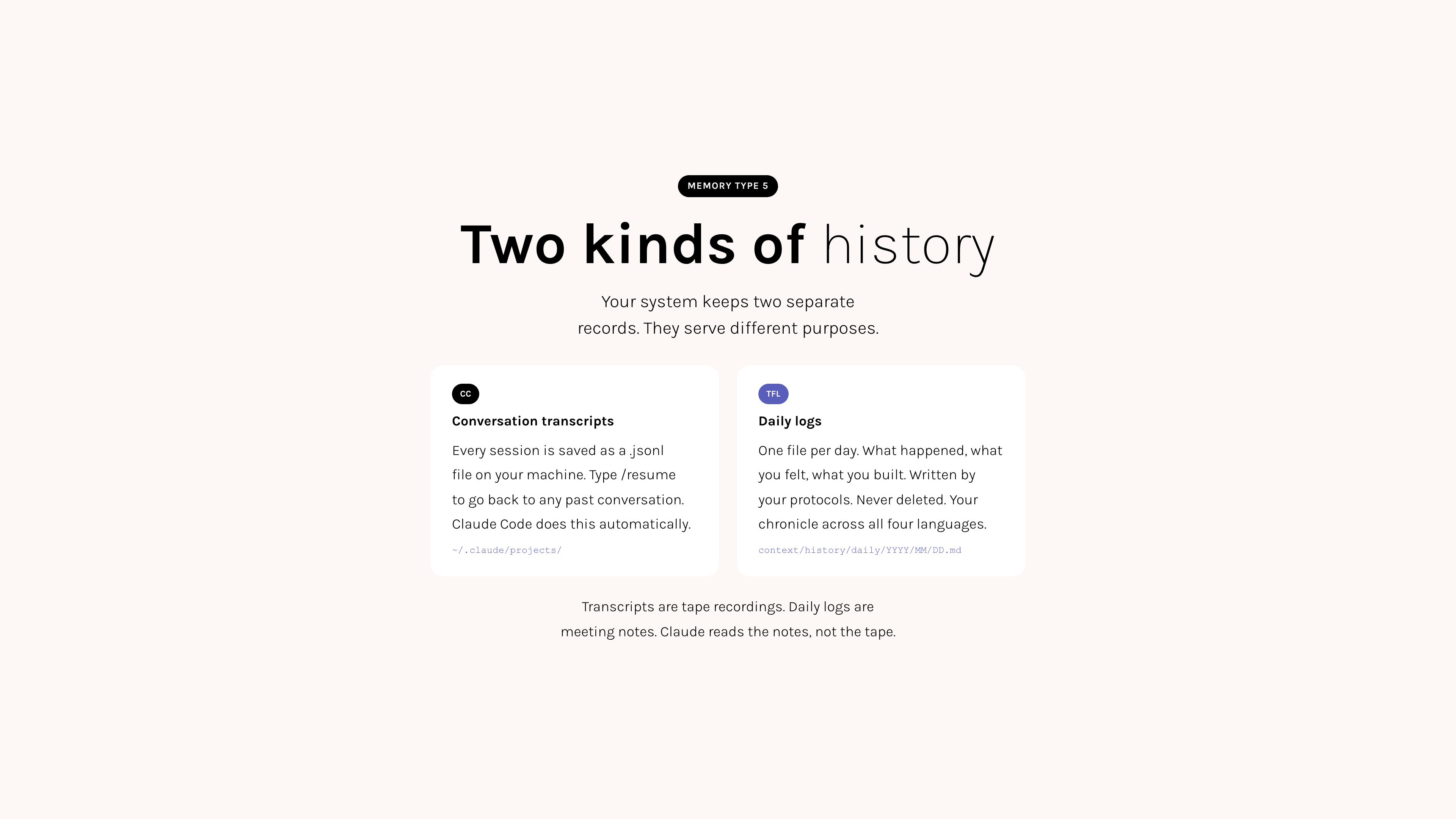
Before we talk about memory, let's clear up something important. Your conversations with Claude are not lost when you close a session. Every conversation is saved as a file on your computer. You can go back to any past conversation, pick up where you left off, and keep working.
Conversations are saved locally
Every session you have with Claude Code gets saved as a file on your Mac. These files live in a hidden folder and they stay there indefinitely. You can browse past conversations in the sidebar, search through them, or resume any of them at any time.
To go back to a previous conversation, type /resume and pick from the list. Or start Claude with claude --continue to jump straight back into your most recent one. The full conversation loads back in, exactly as you left it.
Where conversations live: app vs terminal
If you use Claude on the web (claude.ai), your conversations are stored on Anthropic's servers and appear in a sidebar list. You can scroll through them, search them, and pick up where you left off.
In Claude Code (the terminal), your conversations are saved as files on your computer in a hidden folder called ~/.claude/projects/. Each session becomes a .jsonl file. They stay on your machine indefinitely. You can resume any of them with /resume or jump to your most recent by starting Claude with claude --continue.
In both cases, the conversations are processed through Anthropic's API. The difference is where the transcript file lives after the session ends.
But new sessions start fresh
Here is the important part. When you start a brand new session (not resuming an old one), Claude does not automatically know what happened in previous conversations. It does not read your old transcripts. It starts with a blank slate.
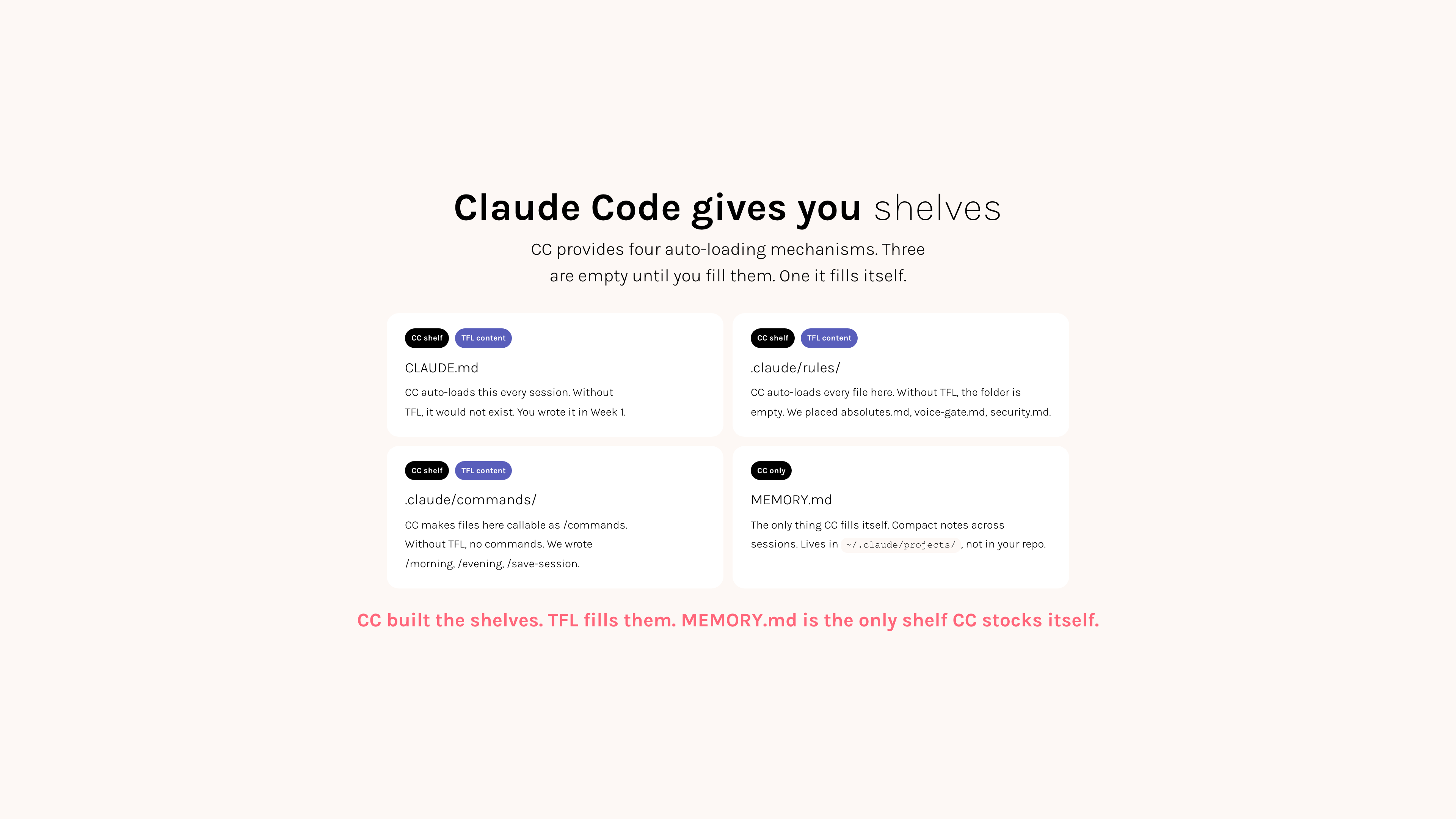
What Claude reads at the start of every new session falls into two groups: things Claude does natively (built into Claude Code itself), and things your Four Languages root system adds on top.
Claude native (built-in to Claude Code)
Those three files auto-load every single session without any action from you. Claude Code reads them before you type your first message. That is the entire automatic load.
Four Languages system (loaded by your morning protocol, not by Claude itself)
context/memory/learnings.md. Read by your /morning protocol Step 1 so Claude does not repeat past mistakes. Only loads if you actually run /morning to start your session.
context/memory/patterns.md. Observations about how you actually work. Scanned by your /morning protocol Step 1, alongside learnings.
context/memory/fact/ are NOT loaded automatically. They load only when a skill or task references them, or when Claude hits the strategic thinking trigger (any "what should I do about" question). This keeps your context window light.
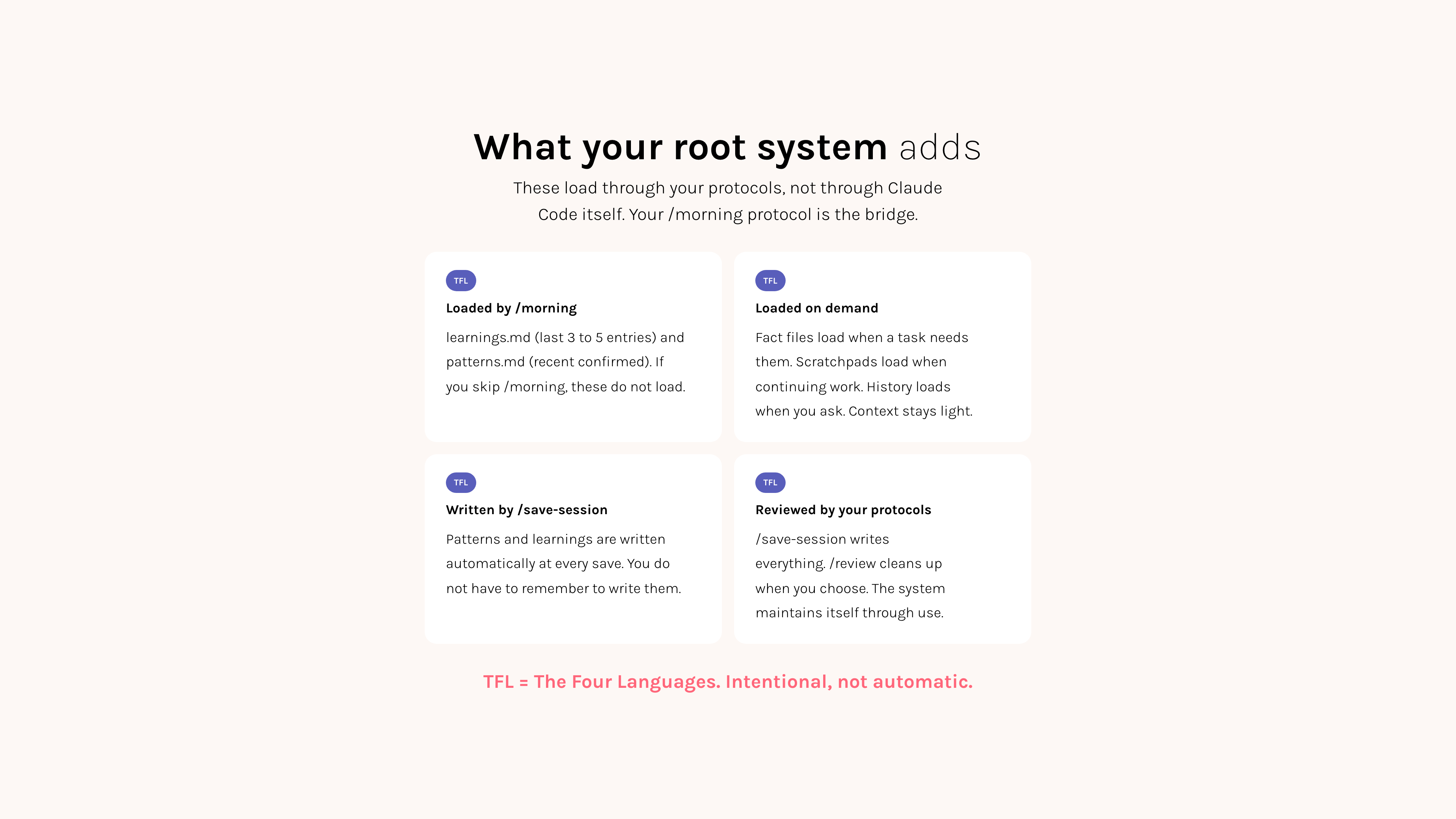
The morning protocol is the bridge between Claude Code's small native auto-load and your full Four Languages memory. If you skip /morning and just start typing, Claude only has CLAUDE.md, MEMORY.md, and rules to work from. That is why /morning matters: it pulls in the recent context from your last few sessions so Claude walks in knowing where you left off.
Zero conversation history loads from prior sessions on its own. Skills, content folders, and history all load on demand when the task requires them.
Watch: save before it compacts
During a long session, Claude compresses older messages to free up space. If you have unsaved work, it can get lost in the compression. This is why the save habit matters: save before context runs low.
The difference that matters
Think of it this way. Your conversation transcripts are a tape recording of a meeting. Saved on your machine, playable anytime. Your root system files (CLAUDE.md, memory, fact files) are the meeting notes you bring to the next meeting. The tape recording exists, but Claude only reads the notes.
This is why your root system matters so much. Without it, you could resume old conversations, but every new session would start from zero. With it, Claude walks into every session already knowing who you are, what you are working on, and how you like things done.
What you build over time
Your root system does not get smarter on its own. It gets better because you teach it how you work. Every file you add, every correction you make, every preference you save is a deliberate choice. Here is what that looks like when you actively build it:
This is the difference between using an AI tool and building a system. The tool guesses. Your system knows, because you taught it.
From the live session: when it gets something wrong, you can fix it
Memory lives in files you can open. In this clip the system had decided Maaria has a child, so she asked where it came from, found the exact file, and deleted the line. Because your memory is editable files, you can correct anything it gets wrong, which a generic AI's hidden memory makes much harder.
Your root system files, conversation transcripts, and daily logs are stored locally in your project folder. But anything you type in a conversation with Claude gets sent to Anthropic's servers for processing, same as any AI tool. The files Claude writes back are local. The conversation itself passes through their infrastructure, and so does any local file the moment Claude reads it. If something is deeply personal and you want it fully private, keep it in a file outside the folder you start Claude in: anything inside that folder is within Claude's reach. The Privacy & GDPR module in Get Set Up covers the reach rule in depth.
From the live session: where your data lives
The privacy conversation from the Dream Diary co-build: what stays in local files, what touches Anthropic's servers, and why that beats apps that quietly sell your data. How Anthropic handles conversation data is theirs to document: see Anthropic's privacy policy rather than any figure quoted on the call.
Turn off training on your conversations
By default, Anthropic may use your conversations to improve future Claude models. You can turn this off. We recommend you do this before you start building your root system.
How to disable training
The setting applies to both claude.ai and Claude Code since they share the same account. How Anthropic handles your conversations depends on your plan, this setting, and their current policy: Anthropic's privacy policy is the place to check.
The toggle has limits worth knowing. It is a setting you can flip back at any time, so treat it as a preference rather than legal protection. And on a personal plan it comes with no data-processing agreement, so if you handle client personal data, the terms you run Claude under matter more than this switch. The Privacy & GDPR module in Get Set Up covers what that means for your business.
This is your first infrastructure decision. It takes 30 seconds and it matters.
Next LessonWhat Claude can reach 🔐
The last lesson covered what gets saved. This one covers the other direction: what Claude can reach while you work. The two together are the full picture of your system's footprint.
The boundary is the folder you start in
When you start Claude Code inside your project folder, everything in that folder is within reach. Files outside it need your permission first, one request at a time. That is why you start Claude inside your system folder rather than your whole Documents folder: the folder you choose is the boundary.
Reach matters even for files Claude never opens. Under GDPR, having access already counts as processing, whether Claude reads the file or not. The Privacy & GDPR page in Get Set Up covers the legal side in full.
From the live session: the folder is the boundary
Everything inside the folder you start Claude in is within reach, and that reach resets the moment you close the terminal. Why you start Claude inside your system folder rather than your whole Documents folder.
The boundary resets every time you start
Close the terminal and the session's access ends with it. Start Claude in a smaller folder tomorrow and yesterday's wider reach is gone. One-time "yes" answers to permission requests end with the session too. If you ever started Claude somewhere too broad, the fix begins at the very next launch.
The exception: saved permissions
Some permission answers stick. When Claude asks to do something and you choose a "don't ask again" option, that choice is written into a settings file inside your project folder, and it keeps working in every future session until you remove it. These rules accumulate quietly. A working system can gather hundreds of them in a few months without you noticing.
Audit your standing permissions
Start from scratch
To clear the accumulated list and approve each access on purpose from now on, paste this:
From then on Claude asks fresh, and each "don't ask again" you choose is a deliberate grant rather than an accumulated one.
Integrations are reach too
Anything you connect to your system, your inbox, your calendar, your database, extends what Claude can reach. Set each connection to pull data only when you trigger it, and to ask before each call. You decide what is within reach, tool by tool, and everything else stays out.
This is the same kind of decision as the training toggle in the last lesson: a few minutes now, structural later. Decide what Claude can reach, audit it now and then, and let the boundary do the quiet work.
This lesson ships as a one-time update for your system. Open the file, paste the instruction at the top into Claude, and it adds one section to your security rules without replacing anything you wrote. From then on the boundary rules live inside your system, where Claude reads them every session.
Your memory system 🧠
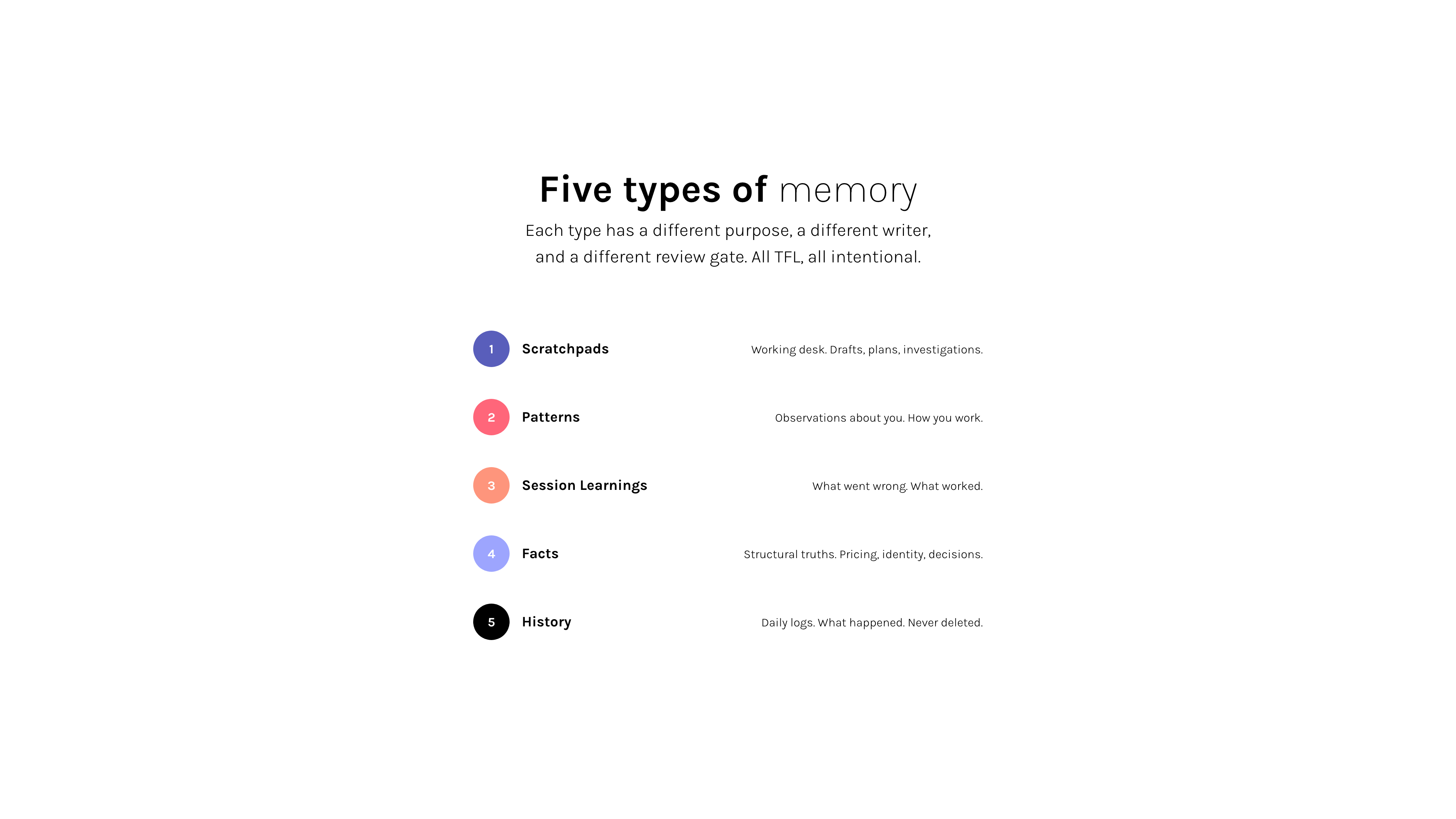
Your root system organizes memory into layers. Each layer has a different purpose and a different writer. Together, they make sure nothing important is lost while keeping your root system clean and current.
The working layers (plus history)
context/pad/
You decide when to clean up
context/memory/patterns.md
You decide when to clean up
context/memory/learnings.md
You decide when to clean up
context/memory/fact/
You decide when to clean up
context/history/daily/
Never deleted
Scratchpads are working notes Claude writes during a session to hold multi-step thinking, build plans, or drafts-before-doing. You do not need to manage them. They live in context/pad/ until you run /review, where you decide together what to keep and what to delete.
Claude opens scratchpads on its own, and you can open one on purpose. Type /scratchpad plus a topic, like /scratchpad pricing-rethink, and your system starts a working file for that thread of thinking. Tomorrow you say "continue the pricing scratchpad" and the thinking is exactly where you left it, mid-thought, ready to pick up.
Patterns are observations about you. Your wording, choices, emotional tells, repeated phrases, energy shifts. Claude appends one to patterns.md at every save. If nothing came up, it skips silently. When you run /review, Claude mirrors the patterns back to you in neutral observation format. You confirm, dismiss, or promote them to a structural fact. No opinions, no judgement, no coaching. You decide what is real.
From the live session: patterns, the layer that sees you
AI quietly assumes things about you based on how you work. The patterns layer makes those assumptions visible in neutral observation, so you can see them, correct them, and decide what is real.
From the live session: what patterns look like after four months
Maren's dream log surfaced an arc across three dreams in four months, plus a synchronicity her system caught before waking life confirmed it. This is the patterns layer doing its job over time, on real entries.
Session Learnings are operational lessons. Mistakes that happened, things that worked, decisions that were made. Claude appends to learnings.md at each save. When you run /review, Claude shows you accumulated entries and you decide together which to keep, promote, or delete. Nothing gets deleted without your explicit approval. The save receipt flags when the file is getting large.
Facts are structural truths. Your pricing, your methodology, your preferences, your boundaries. They live in context/memory/fact/ as YAML files. Read on demand by skills and by the strategic thinking trigger. Audited when you run /review, or when Claude reads a fact file during a task and flags drift.
History is one file per day. Your immutable record of what happened. Never deleted. Never edited after the fact.
How cleanup actually works
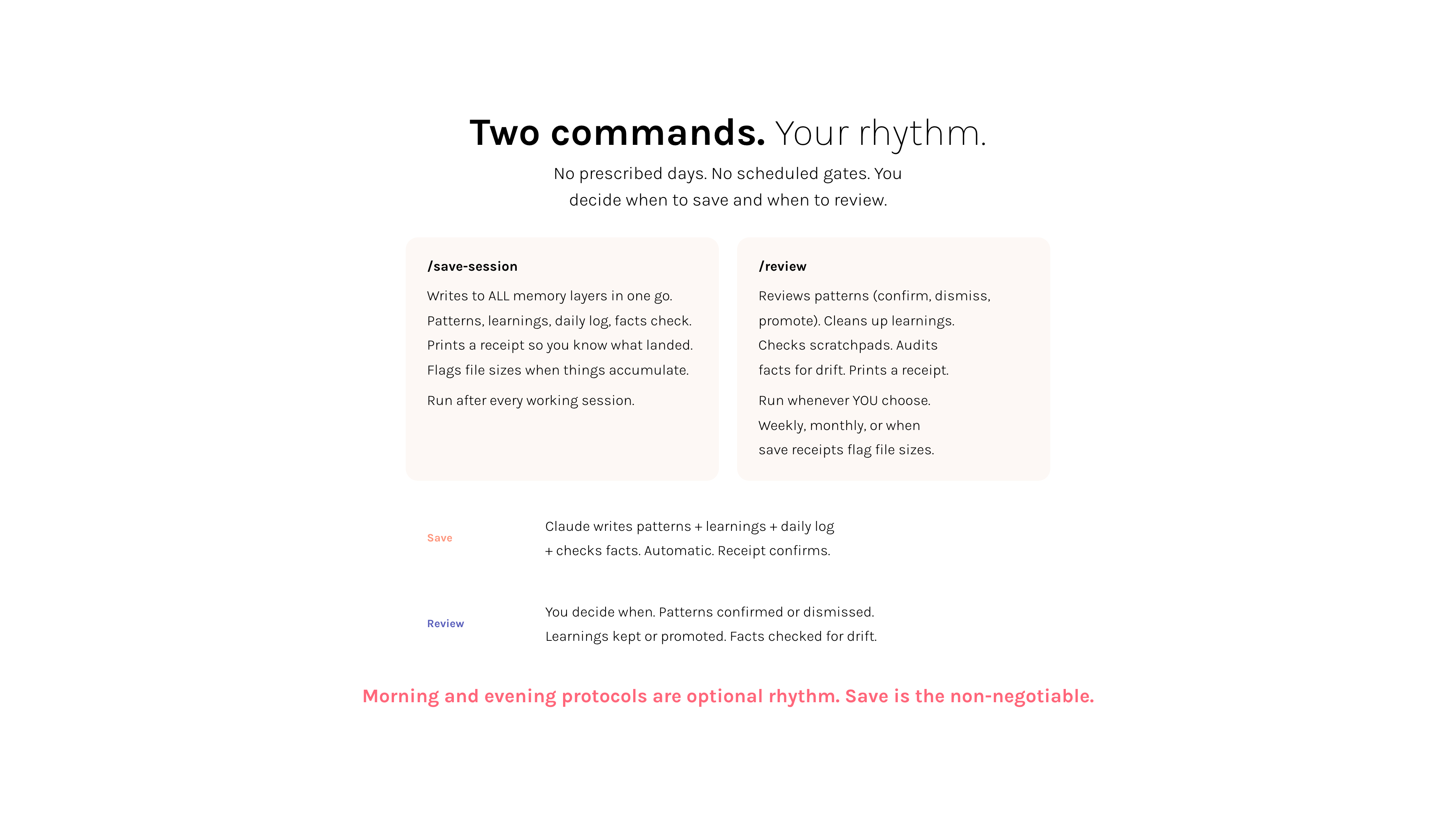
Nothing expires automatically. Claude has no internal clock or timer. It cannot track "this file is N days old" on its own. What keeps the system clean is two commands working together: /save-session and /review.
- Every save: Claude appends to
patterns.mdandlearnings.md. This happens automatically as part of/save-session. - When you choose to clean up: Run
/review. Claude walks through your patterns (confirm, dismiss, promote), your learnings (keep, promote, delete), your scratchpads (keep or delete), and your facts (still true?). You decide the rhythm. The save receipt flags when files are getting heavy if you want a signal.
Your only job when you run /review is to answer in plain language: keep, promote, delete, still true.
The full walk-through of this structure, file by file: the exact folder layout, what belongs in each layer, and what stays out. Ask Claude to open
guides/08-memory-system.md and walk you through it.Teaching it more every day 🌱
Every interaction teaches your root system something new. Not because it is recording everything in some hidden database, but because the files in your root system grow and refine with use. The question is not whether it learns. It is how fast.
From the live session: a symbol library built from your answers
When something new appears in a dream, the system asks what it means to you and saves the association. Blue shoes, crocodiles: your meanings rather than a dictionary's. The same teach-it-as-you-go mechanic works for anything you track.
Daily check-ins
The simplest way to teach your root system is to start each session by telling it how you are. Energy level, what you are working on, what is on your mind. These get logged, and over time your root system builds a picture of your rhythms. You will set these up properly in the next module.
Voice refinement
When Claude writes something that sounds off, tell it. Be specific. The more direct you are, the faster your voice guide sharpens.
Every correction gets saved. After a week of daily use, the difference is real. After a month, Claude writes in your voice without being asked.
Saving your sessions
At the end of a work session, you want to save what happened so your root system remembers it next time. Just say "save" or type /save-session. Claude runs a multi-step save process. Every step is verified. Every failure is visible.
patterns.md as unconfirmed. If nothing came up, it skips silently. No null lines.
learnings.md. Things that went wrong, fixes that worked, technical gotchas worth remembering.
context/history/daily/YYYY/MM/DD.md gets updated with completed items, energy, and notes.
When the save finishes, Claude prints a receipt showing every step as confirmed, skipped, or FAILED. Always check it. If any step says FAILED, tell Claude to retry before you close the session.
The receipt is not just a summary. Asking Claude to account for every step is what keeps it honest: when it has to show its work, it stops quietly skipping a step it would otherwise drop without telling you. That silent skip is the failure mode the receipt is built to catch.
What a save receipt looks like
1. Patterns: 2 written
2. Learnings: written
3. Daily log: updated
4. Facts: no updates
5. File health: ⚠ learnings: 215 lines ⚠ 4 pads
6. Git: committed
Your evening protocol (which you set up in Module 3) triggers this full save process automatically. But you can also save mid-session whenever you have done something worth keeping. The word "save" is the trigger. Say it, and the full process runs.
The receipt tells you exactly what landed, what was skipped, and whether your memory files are getting large. When file health shows warnings, that is your natural trigger to run /review and clean up. No scheduled days, no gates to remember.
When something feels off: /context-status
Some days Claude seems to miss something it should know. Before you assume the system broke, look at what it actually knows. Type /context-status and your system prints a health report: which fact files exist and which are still empty, how many learnings and unconfirmed patterns are waiting, which scratchpads are open, and whether today's log exists.
Type /context-status after your next save. An empty fact file or a missing daily log in the report is your system pointing at exactly where to look next. A quick glance once a week keeps surprises away.
Reflective practice
Your root system can support whatever grounds you. Journaling, meditation, gratitude practice, prayer, time in nature. You choose what matters. Tell your root system about your practice, and it will prompt you, log your reflections, and track your consistency.
The files your root system writes are stored locally on your computer. But anything you type in a conversation with Claude goes through Anthropic's servers for processing, the same as any other message. If your reflective practice is deeply personal and you want it fully private, keep it in a file outside the folder you start Claude in, because whatever Claude can reach can travel to Anthropic the moment it reads it. Your root system can still track consistency and prompt you without reading the content.
If you are tired, say so. If you are avoiding something, say that too. Your root system does not judge. It just learns how to support you better.
Your fact files 🗂️
Inside your memory system, there is a folder called context/memory/fact/. This is where permanent truths live. Things that do not change session to session. Your name. Your boundaries. How you prefer to work. What you have decided and why.
Your kit comes with eleven fact file templates, each in YAML format. YAML is just a simple way to store structured information that both you and Claude can read. You do not need to learn any syntax. Your onboarding conversation in Module 1 already filled several of them. This lesson is where you see the full set and close the gaps, by talking to Claude while it writes the files for you.
The eleven fact files
identity.yaml
Who you are. Your name, your role, your timezone, your location, your core values, how you communicate. This is how Claude knows the person it is working with.
business.yaml
Your work. Your methodology, your offerings, who you serve, and how you help. Written by your onboarding conversation, and the file that defines your dream client for everything that comes later.
brand.yaml
Your visual identity. Website, colors, fonts, logo, style notes. When you build pages and posts later in the course, Claude reads your palette from here instead of asking again.
preferences.yaml
How you like things done. Your tools, work hours, morning routine, planning style, writing style, how you want Claude to respond. The more specific you are, the less you need to correct.
constraints.yaml
Your hard limits. Budget, time available, non-negotiables, tools you refuse to use, topics that are off-limits, accessibility needs. These are your guardrails that Claude respects absolutely.
decisions.yaml
Choices you have made and the reasoning behind them. Pricing decisions, platform choices, positioning calls. When Claude knows WHY you decided something, it stops suggesting alternatives you already rejected.
goals.yaml
Where you are heading. Your 12-month vision, your current goal, what success looks like. Claude weighs its suggestions against these instead of against generic best practice.
current-state.yaml
Where you are right now. Life phase, business phase, energy level, primary focus, quarterly goals, and what is in your way. This is the only fact file that changes often. It keeps Claude oriented without you explaining your context every session.
tech-stack.yaml
The tools you run on today, what they cost each month, and what you wish was automated. In Part 2, when you start replacing subscriptions with your own system, this file is the map.
personal.yaml
Tendencies and structural truths about how you actually operate, promoted from patterns.md when you confirm them. Starts empty. Grows over time as Claude notices patterns and you say "that's actually a fact about me" when you run /review.
skills-registry.yaml
A catalog of every skill your root system can run. Maps skill names to their purpose so Claude knows what tools are available. This one fills itself as you add skills.
How to fill them in
You do not need to write YAML yourself. Just talk to Claude. Tell it about your business, your preferences, your boundaries. It will organize everything into the right files.
Your setup prompt
Claude will interview you, one file at a time. It asks questions, you answer in plain language, and it writes clean YAML. You review it, approve it, and move on. Two of the eleven start empty on purpose: personal.yaml grows from patterns you confirm, and skills-registry.yaml fills itself as you add skills.
When fact files actually load
Important: fact files are not loaded into every session automatically. Only your CLAUDE.md and your rules in .claude/rules/ auto-load every session. Fact files are loaded on demand: when a skill references one, when your morning protocol asks for current state, or when Claude hits the strategic thinking trigger (any "what should I do about" question). This is deliberate. It keeps your context window light and lets fact files grow detailed without slowing every conversation down.
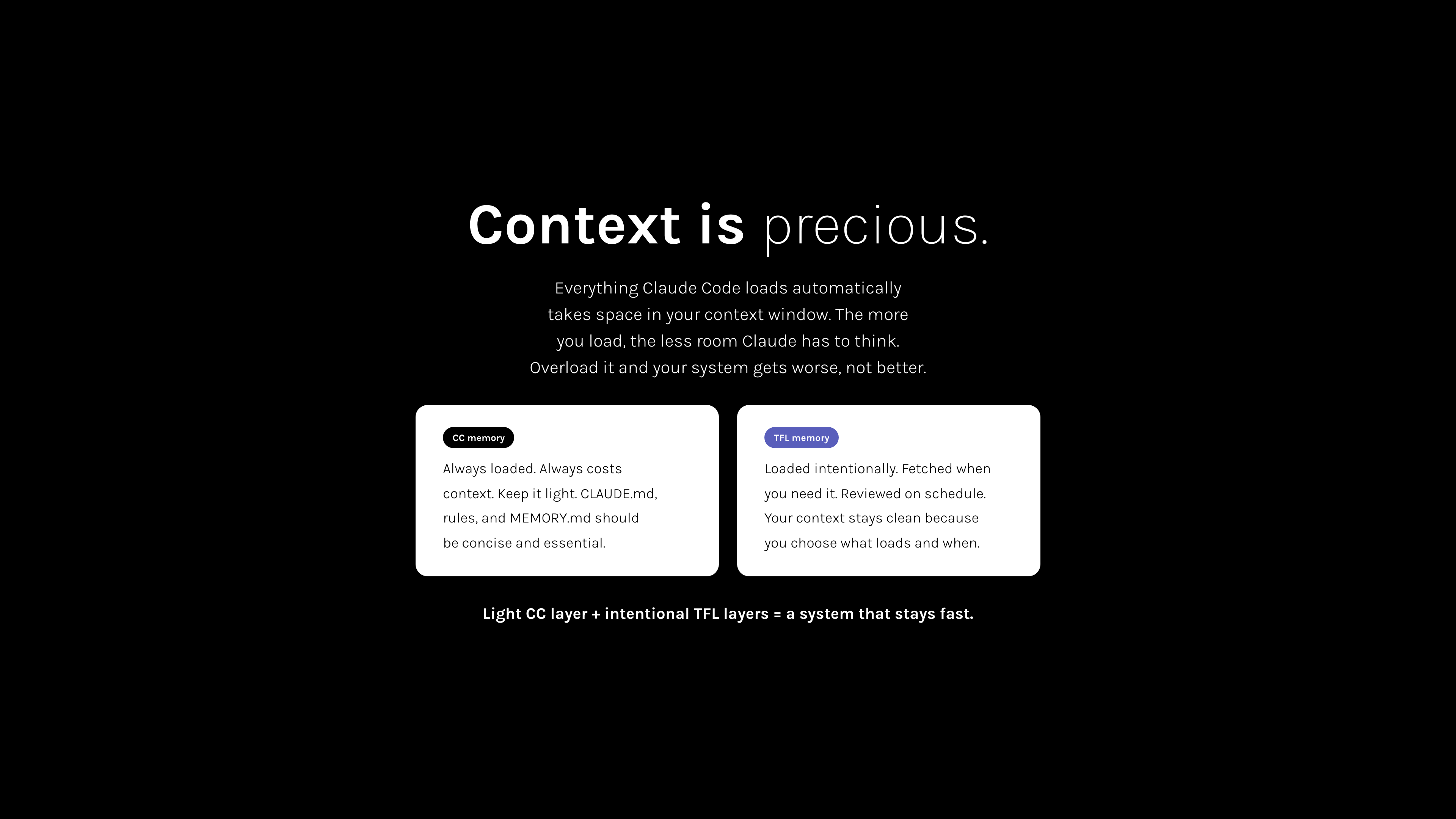
ALWAYS LOADED (every session, by Claude Code)
CLAUDE.md (root file)
MEMORY.md (Claude native auto-memory)
.claude/rules/ (all rule files)
LOADED ON DEMAND
learnings.md + patterns.md (by /morning)
Fact files (when a skill needs one)
Skills (when you run them)
Content folders, history (when referenced)
Fact files vs skills: know the difference
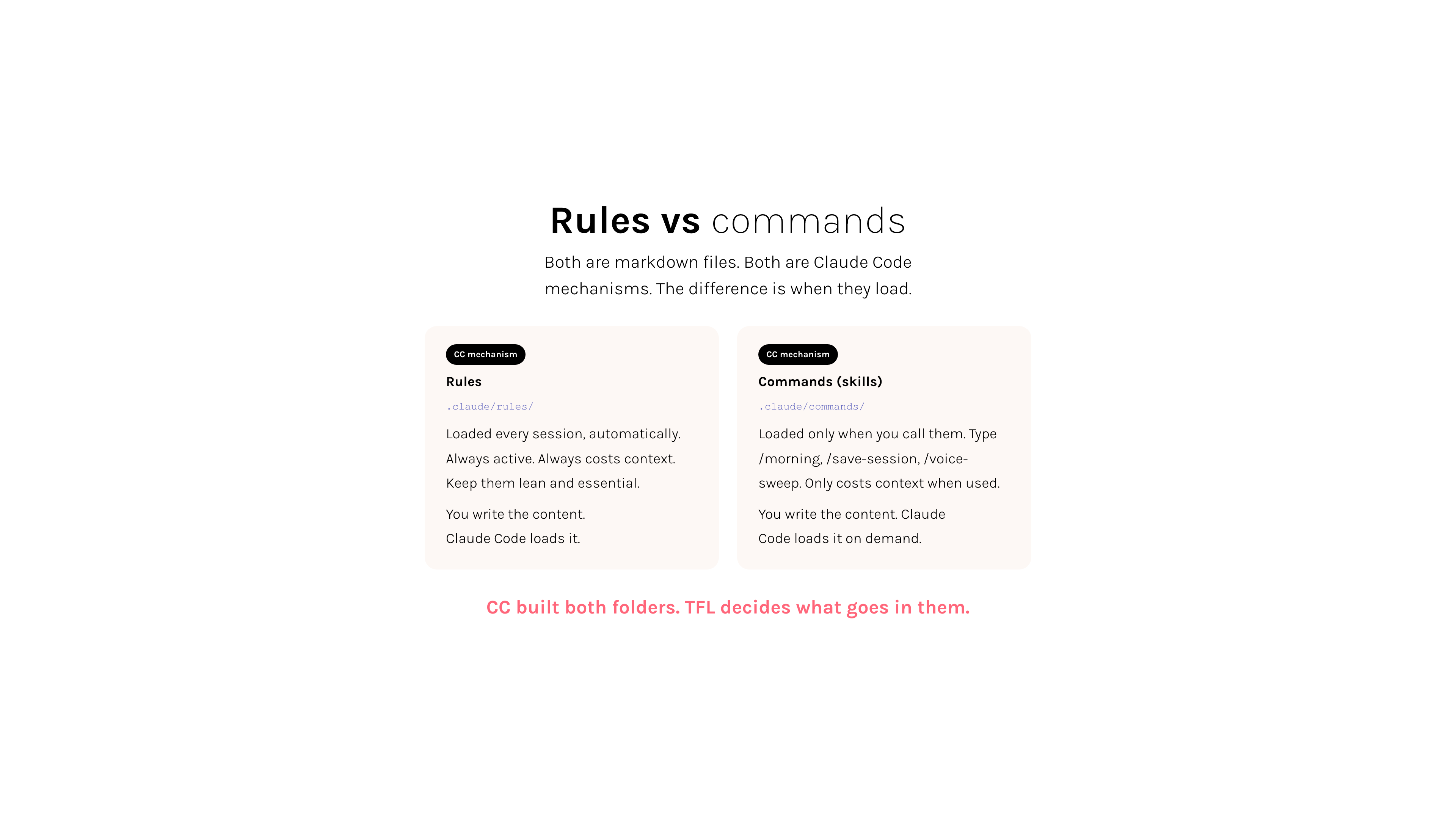
Fact files hold your permanent baseline. Things that are true regardless of what you are working on today. Skills hold the detailed instructions for specific tasks. When you run a skill like /content-week or /crm, that skill file loads with all of its specific rules and templates. When the task is done, that context goes away.
This means your fact files do not need to contain everything. If your brand guidelines only matter when you are creating content, those details belong in a content skill, not in your fact files. If your CRM rules only matter when you are logging contacts, those belong in your CRM skill. Fact files carry your baseline truth. Skills carry the operating manual for specific work.
From the live session: how your system holds your strategy
Before it researches or suggests a change, your root system reads your fact files: identity, strategy, current state. Its advice is grounded in who you are and what you have decided, not generic guidance.
The golden rule: if it does not describe WHO you are or WHAT you have decided, it probably does not belong in a fact file
A good test: if a skill could do its job without reading this line, it probably belongs in the skill instead. Your identity? Fact file. Your brand colors? Fact file, because every content skill reads the same palette from brand.yaml. Your pricing decisions and the reasoning behind them? Fact file. Your carousel slide template? Skill.
Example: a lean identity.yaml
role: Business strategist for creative solopreneurs
timezone: America/Los_Angeles
values: [depth, honesty, rest]
communication_style: Direct, warm, no corporate speak
Five lines. That is enough for Claude to know who it is working with. Everything else loads when it is needed.
Fact files are the few things you keep on your desk at all times. Skills are the drawers you open when you need something specific. If your desk is covered in papers, there is no room to work. Keep the desk clear. Use the drawers.
Organize your knowledge: the map and the terrain 🗺️
In Module 1, you brought your existing knowledge into your system. Files, frameworks, client data, notes. Now it is time to organize WHERE everything lives so your root system knows how to find it and when to load it.
This is the difference between having a pile of useful files and having a system that routes to the right information at the right time.
The map vs the terrain
Your root file (CLAUDE.md) is the map. It does not hold all the details. It tells Claude where the details live and when to load them. The terrain is everything else: your fact files, your skills, your rules, your content, your data.
When Claude opens a new session, it reads the map first. From the map, it decides what to load based on what you are doing. If you are writing content, the map points to your voice guide and content skills. If you are managing contacts, the map points to your CRM skill and contact data. The map stays small. The terrain can grow endlessly.
THE MAP (always loaded by Claude Code)
CLAUDE.md (root file)
MEMORY.md (auto-memory)
Rules (.claude/rules/)
Small, lean, points elsewhere
THE TERRAIN (loaded on demand)
learnings.md + patterns.md (by /morning)
Fact files (when a skill needs one)
Skills (.claude/commands/)
Content hub, CRM data
Rich, detailed, loaded when needed
Where each type of knowledge lives
Here is a concrete guide for deciding where to put things. Go through the files you imported in Module 1 and ask: what type of knowledge is this?
CLAUDE.md (your root file)
The routing table. What files exist, where they live, when to load them. Your protocols (what happens when you say "good morning" or "save session"). Your key file locations table. Keep it lean. If it is longer than a few pages, you are putting terrain in the map.
Rules (.claude/rules/)
Non-negotiable instructions that apply EVERY session. Your writing style rules ("never use em dashes"). Your security rules ("never commit API keys"). Your visual design rules. Think of these as your absolutes. Claude loads all rules automatically at the start of every session, so keep them short and universal.
Fact files (context/memory/fact/)
Permanent truths in YAML format. Your identity, preferences, constraints, decisions, current state, personal patterns. Loaded on demand: when a skill needs one, when your morning protocol asks for current state, or when Claude hits the strategic thinking trigger. Keeping them on demand instead of always-on keeps your context window lean.
Skills (.claude/commands/)
Detailed instructions for specific tasks. Your content creation process, your CRM workflow, your morning protocol, your email templates. Skills are loaded ONLY when you run them. A skill can be pages long because it only uses context when it is active.
Four language folders (soul/, mind/, heart/, body/)
Your actual content and data. Frameworks in mind/. Voice guide and content in heart/. Dashboard data in body/. Reflective practice in soul/. Claude navigates here when a task requires it, guided by the map in your root file.
From the live session: how long should the root file be?
The real answer depends on how you use your system. Narrower focus can be longer. Wider use means keeping it short and moving detail into skills.
The sorting exercise
Ask Claude to help you audit where your imported files ended up and whether they are in the right place. This is the prompt that makes the difference:
Your setup prompt
The full version of this exercise: where each kind of file lives, how to move what landed in the wrong place, and what a healthy layout looks like after a month of use. Ask Claude to open
guides/09-organizing-your-knowledge.md and work through it with you.Common mistakes
A well-organized system with 20 files beats a messy system with 200 files. The architecture is the intelligence.
Your CRM: the people your system remembers ❤️
Your memory system remembers what happened. Your CRM remembers who it happened with. This module's pack ships a complete CRM for the people in your world: who they are, what you talked about, what you promised, and what's next.
It lives in your own files
Your contacts live in heart/crm/ as plain files Claude reads and writes: contacts, activities, deals, tasks. They sit on your machine, work offline, and move with your system, and you can open them yourself any time. When a tool holds your relationships, you want to own the tool.
You talk, Claude writes
You say what happened, in plain language, and Claude keeps the record:
That last one is the payoff. Before a call, Claude reads the whole story back to you: how you met, what you promised, what happened last time, what comes next. You walk in knowing, and it shows.
One habit makes it work
Everything that touches a person gets logged in the moment it comes up. A reply, a call, a note. The timeline is what makes the CRM useful: your system can only read back a story that got written down.
/crm-log is the fast lane. Paste a LinkedIn thread, a WhatsApp exchange, or an email reply, and Claude finds every person in it, logs each one, and prints a receipt. Or give it one line:
The moment you think "I should note that somewhere" is the moment. Five seconds now beats reconstructing a conversation from memory in three weeks.
Promises are sacred
When you tell someone "I'll send you that link", your system records it as a promise with a due date and a status. Ask "what have I promised people?" and everything you said in passing comes back to you before it slips. For a solopreneur, kept promises are the reputation.
Consent, from day one
Every contact carries a consent level: sequence (they opted in to automated emails), manual-only (personal messages only), or quiet (do not contact). Claude checks it before anything goes out. People you import from LinkedIn are always manual-only, because connecting with someone is not the same as them asking for your emails. You will meet this again in the next lesson.
Under the hood: how the CRM thinks
Contacts move through stages: new, engaged, in conversation, opportunity, client. Each activity type carries a score (a call is worth more than a sent email), and scores fade over time, so someone you talked to last year does not outrank someone you talked to last week. Claude promotes contacts on its own as real signals accumulate: a reply moves someone from new to engaged without you touching anything.
The full data model, scoring table, and stage rules live in the /crm skill file. Ask Claude to explain any part of it, or to change the scoring to match how your business actually works.
Tell Claude: "Add [name] to my CRM." It asks how you met and what happens next. Start with one person you are actually talking to this week and let the rhythm build. Your whole network arrives in the next lesson, and it lands in this same CRM.
In Part 2 this grows into your full relationship engine: sequences in your voice, follow-ups that surface on their own, your CRM connected to the places real conversations happen. Everything you log from today carries straight into it.
Next LessonTeaching it your network 🤝
From the live session: LinkedIn safety
What to know about LinkedIn's restrictions on AI tools before importing your network. The safe way to do it.
The fastest way to teach your system is to give it real data. Your LinkedIn connections are one of the richest sources you already have. Hundreds or thousands of people you have met, worked with, or connected with over the years. Your root system can read through all of them, tell you who matters most for where you are going, and land every one of them in the CRM you met in the last lesson.
Export your LinkedIn connections
Go to LinkedIn Settings > Data Privacy > Get a copy of your data > Connections. LinkedIn will email you a CSV file (usually within 10 minutes). Download it and drop it into your project folder.
Let your system classify them
Run /import-linkedin and your root system reads through every connection and scores each one against your dream client profile: strong, medium, or none. The skill ships with a starting list of role keywords to match against, and you tune it before the first run. Sell to lawyers? Legal roles go in. Coaches and practitioners? They are already there. Tell Claude who you serve and the classification becomes yours.
Analyze your network
Then run /network-analysis to get strategic recommendations. Who should you reconnect with? Where are the clusters of aligned people? What patterns show up in your network that you have never noticed?
Go deeper on your best matches
For your strongest matches, run /lead-enrichment to pull more context before you reach out. This gives you something real to say when you reconnect, not a generic "hope you are well" message.
Where you will see it
The import writes into the same files your CRM uses, plus a network summary. Ask Claude to "show my strongest matches" or "break my network down by industry" and it reads the answers back any time. In Module 4 you build your dashboard, and its Network tab draws from exactly this data:
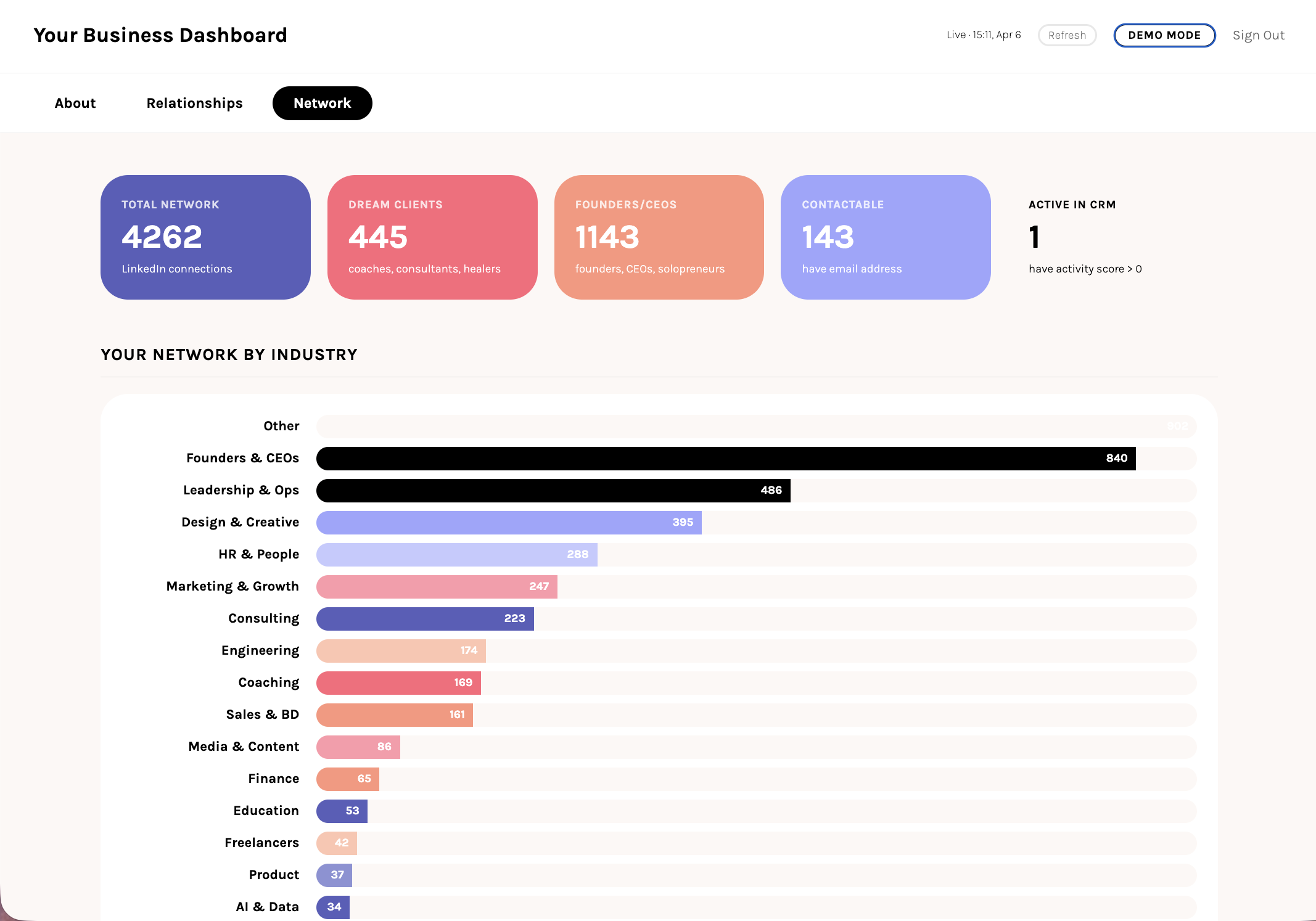
Your network, through your lens
Every connection is classified against your own profile, so the people who match what you described show up first. Two modules from now, this view becomes one tab of a dashboard built from your real data.